Moving a hot tub is not the same as moving a sofa, cabinet, or standard appliance. The work involves a heavy, rigid spa shell, awkward dimensions, plumbing, electrical components, a cabinet that may not be safe to lift from, and access challenges that can change the entire moving plan.
D1 Moving and Storage helps customers across Northern VA, Washington DC, Richmond, Virginia Beach, Charlottesville, Roanoke, and surrounding Virginia communities plan moves that involve difficult access, careful handling, packing, storage, and related moving needs. If you have questions about whether a spa can be moved safely as part of a larger relocation, you can reach out through D1 Moving and Storage.
Hot tubs require more planning than ordinary heavy-item moving
A drained hot tub can still weigh hundreds of pounds, and some models can weigh more than 1,000 pounds depending on size, frame, insulation, equipment, and remaining water. Weight alone is not the only issue. The shell may be acrylic or fiberglass, the cabinet may be decorative rather than structural, and the equipment bay may contain parts that can be damaged if the tub twists, drops, or shifts.
That is why experienced hot tub moving companies do not begin with a simple hourly estimate. They start by identifying what kind of spa is being moved and what the route will demand. A portable spa on a flat patio is very different from a partially recessed unit built into a deck or a spa blocked by fencing, stairs, landscaping, or a tight side yard.
A proper assessment documents the spa’s length, width, height, estimated weight or manufacturer specifications, cabinet shape, control pack location, and equipment access. Crews also confirm whether the unit is a portable spa, swim spa, built-in model, or partially recessed installation. Those details affect how the tub can be lifted, tilted, protected, loaded, and transported.
The access route matters just as much as the spa itself. Movers measure from the existing pad to the truck and from the truck to the new location. They look at gates, doors, corners, hallways, overhead clearance, stairways, fences, retaining walls, slopes, landscaping, soft soil, gravel, and truck loading dimensions.
A route that looks open at first glance may still require specialty handling. A narrow gate may need temporary removal. Stairs may require an appliance dolly or stair-climbing equipment. A tub trapped behind a fence, house, trees, or elevation change may need crane or hoisting support. One industry guide comparing hot tub moving methods notes that access conditions often determine whether standard ground moving is practical or whether another method is safer.
Draining, disconnecting, and removing parts reduce risk before lifting begins
Preparation usually starts before anyone tries to lift the spa. The tub should be switched off at its dedicated breaker and GFCI protection. If the hot tub is hardwired, the electrical connection should be isolated and disconnected by a qualified electrician. Moving crews should not improvise with energized wiring or treat electrical disconnection as ordinary loading work.
Once power is addressed, the tub is drained through its drain valve or with a utility or submersible pump. Draining is not always the end of water removal. Residual water can remain in jets, plumbing lines, pump housings, low points, and the equipment compartment. A wet-dry vacuum can help remove that remaining water, which reduces weight and limits water damage while the spa is being tilted, carried, or transported.
Removable items should be taken off and packed separately. This keeps small parts from breaking loose and prevents accessories from creating pressure points against the shell or cabinet during transport.
Common items removed before moving a hot tub include:
Filters
Steps
Cover lifters
Handrails
Pillows
Loose panels
Accessories and removable components
The equipment bay should also be inspected before moving. Loose control panels, pump components, doors, and cabinet pieces need to be secured so they cannot strike the shell, fall out, or catch on obstacles during handling.
The destination should be confirmed before the hot tub is loaded. The new pad should be prepared, level, structurally adequate, accessible, and clear of obstacles. Any electrical, plumbing, drainage, code-related, or technical spa work should be assigned to the appropriate licensed trades or qualified spa technicians.
This step is easy to underestimate. If a spa arrives at a location that is not ready, the crew may have to hold the unit on equipment longer than planned, place it temporarily, or move it again later. A clear destination plan reduces handling and helps prevent avoidable stress on the tub.
Professional hot tub movers match equipment to the route, not just the weight
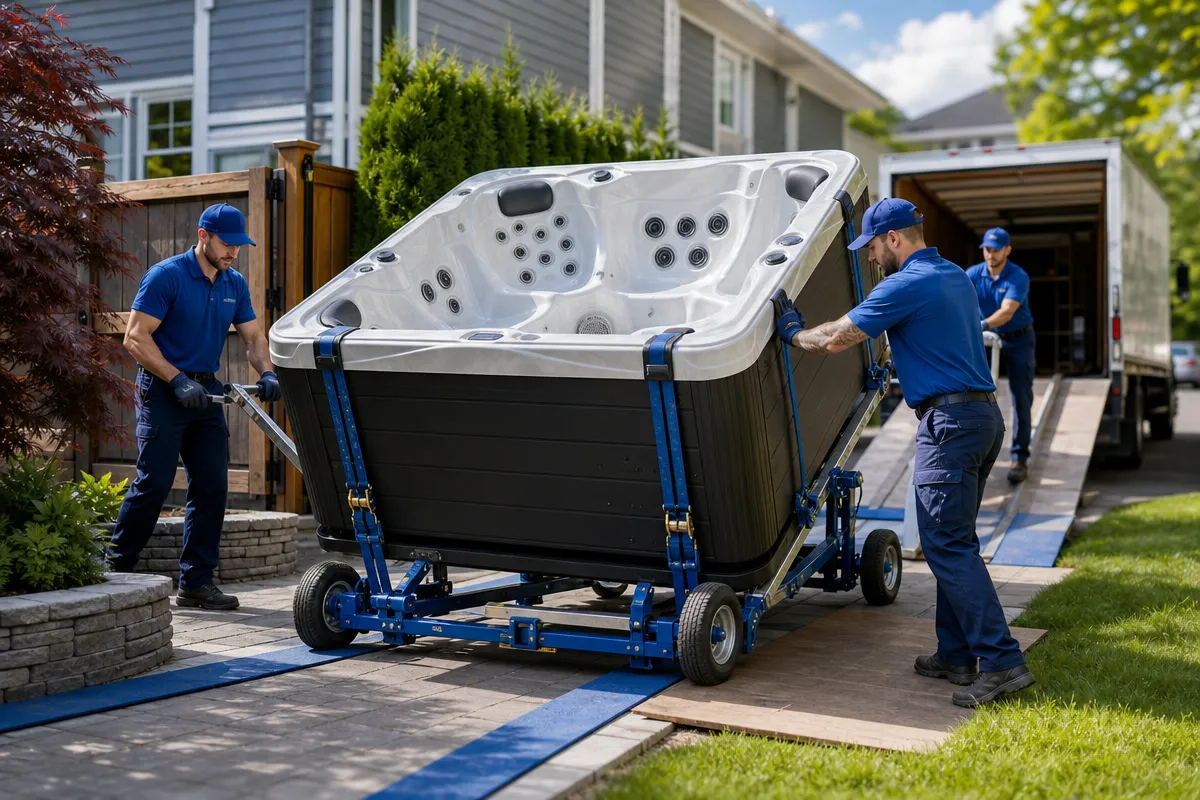
Specialized hot tub moving depends on having the right equipment for the specific property. A heavy-duty dolly may be enough for one route, while another move may require plywood roads, stair glides, ramps, winches, straps, sleds, blocking, or crane coordination. The right method depends on weight, slope, stairs, surface conditions, and turning space.
Movers commonly use heavy-duty four-wheel furniture dollies, spa dollies or sleds, appliance dollies with stair glides, lifting straps, ramps, 4x4 blocking, plywood sheets, winches, and ratchet straps. These tools help distribute load, control movement, and reduce the need for unsafe manual lifting.
Plywood is often used to create a temporary road across grass, gravel, mud, or soft soil. This helps distribute loads and gives dollies or sleds a more stable path. Lumber blocking can create clearance beneath the spa base so equipment can be positioned without forcing the crew to lift the entire spa by hand.
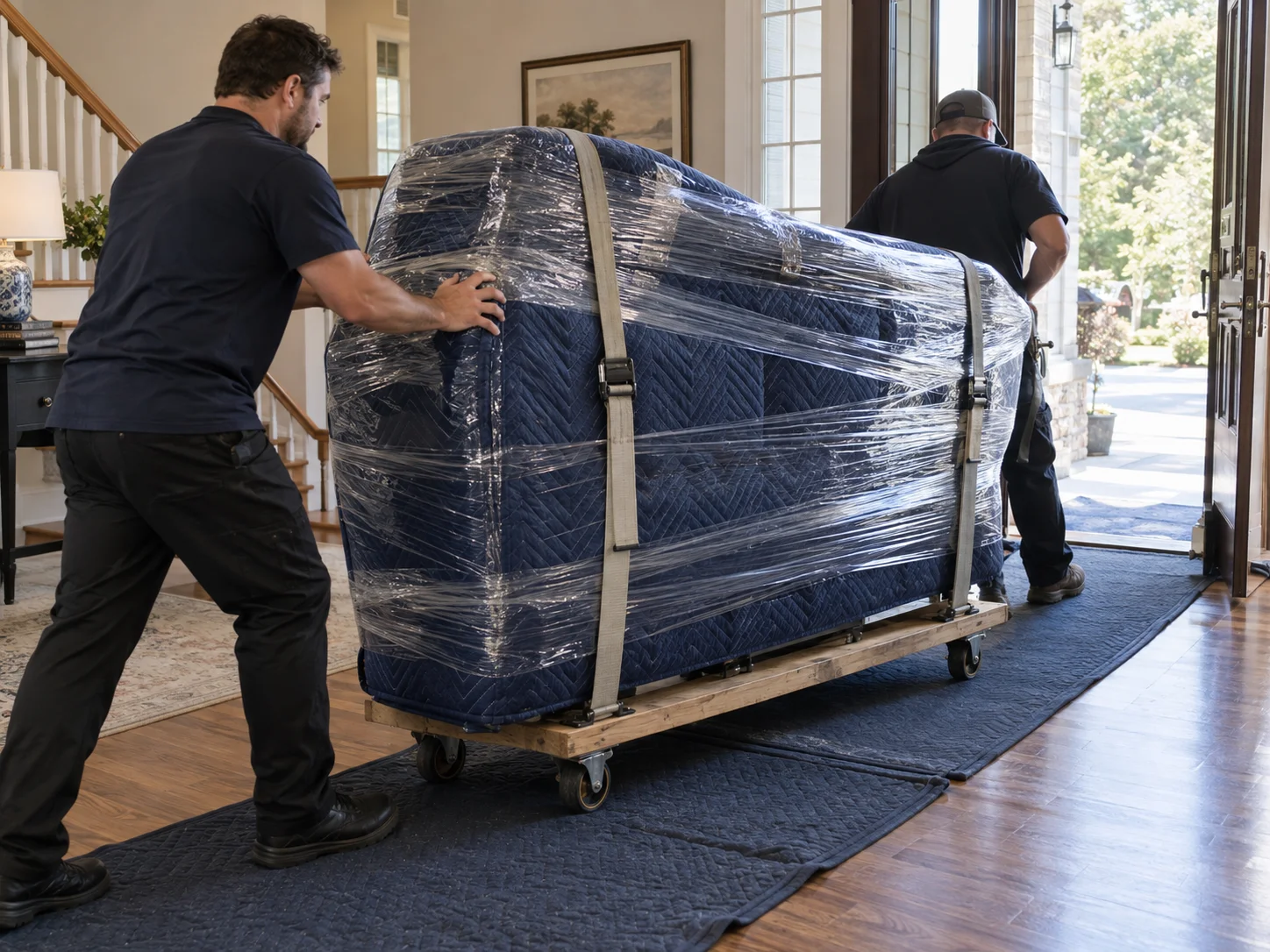
Protection is part of the equipment plan. The shell and cabinet may be wrapped with moving blankets, corner pads, shrink wrap, or protective tarps. Door jambs, walls, railings, deck edges, gates, and other contact points can be padded. Floors may be covered with runners, plywood, or other protective materials.
This planning is especially important in Virginia and the District of Columbia, where narrow urban side yards, mature plantings, retaining walls, fences, decks, and uneven terrain can make the access route more difficult than the spa itself. D1 Moving and Storage regularly works in communities where tight property access and careful protection are central to a successful move.
A safe lift also depends on knowing where not to lift. A hot tub should not be lifted by its top rim, cover, control panel, plumbing lines, or unsupported cabinet sections. Loads should be distributed through suitable structural areas while the crew controls tilt and movement. The goal is to prevent twisting, dropping, or concentrating force in one fragile area.
Stairs, slopes, gates, decks, and tight spaces change the moving method
Access challenges are often the deciding factor in whether a move is straightforward or highly specialized. A hot tub’s size can make a flat route difficult, but stairs, slopes, narrow gates, decks, and tight corners raise the risk of injury, property damage, and damage to the spa.
Stairs are especially demanding because the spa’s center of gravity shifts as the crew manages a large, rigid load. Movers may use an appliance dolly with stair glides, a stair-climbing system, controlled straps, additional personnel, or a different route. The chosen method should keep the tub controlled at every step rather than relying on strength alone.
Slopes and uneven terrain also require careful control. Pushing a dolly downhill or across soft ground can allow the tub to roll, tip, or slide. Crews may use plywood roads, 4x4 boards, sleds, winches, wheel chocks, and spotters to slow movement and maintain direction.
Gates, corners, and narrow passages need more than a quick width check. Crews evaluate the tub’s actual diagonal and vertical dimensions. Depending on the model and construction, they may rotate the spa onto its side, remove a gate, partially disassemble nearby structures, or select a crane when ground access is not practical.
Decks require two separate checks. First, movers need to know whether the hot tub can pass through the opening and whether railings or stairs must be temporarily removed. Second, the deck’s ability to support the tub, crew, dollies, and concentrated wheel loads must be considered. Clearance and structure both matter.
Crane service may be appropriate when a spa must pass over a fence, house, wall, trees, or another obstruction. Crane-assisted moving adds planning for staging, overhead hazards, weather, lifting points, permits or approvals, and coordination between the crane operator and moving crew. This is not a last-minute decision. It should be identified during the route assessment.
Loading, transport, and placement protect the spa after it leaves the yard
Once the spa is on a rated dolly or sled, loading must be matched to the truck and the tub’s orientation. Movers may use a ramp, liftgate, winch, or controlled manual loading method. The truck or trailer must accommodate the hot tub’s dimensions, weight, padding, and support needs.
Inside or on the vehicle, the spa should be placed on stable support. It should be protected from direct contact with walls, flooring, metal edges, and other cargo. Rated tie-down or ratchet straps, blocking, chocks, blankets, and edge protectors help prevent sliding, tipping, shifting, and abrasion during acceleration, braking, turns, and rough roads.
Transport planning includes distance, road conditions, loading height, vehicle payload, parking restrictions, delivery access, and weather exposure. Long-distance moves generally cost more because they require more time, fuel, equipment, coordination, and protection.
At the destination, the process is reversed. The crew unloads the spa, moves it along the prepared route, removes protective materials, and places it on the prepared pad. The tub should be leveled before filling because an uneven base can stress the frame, cabinet, shell, plumbing, and equipment.
Reconnection should follow the agreed scope. A qualified electrician reconnects hardwired power. A spa technician or appropriately qualified installer checks plumbing, unions, pumps, controls, filters, and leaks before the tub is filled and energized.
Choosing a hot tub moving company starts with scope, access, and accountability
Cost depends on much more than distance. Major estimate variables include the tub’s size and weight, model type, crew size, stairs, slopes, tight gates, narrow corridors, deck or fence removal, soft ground, landscaping, crane or hoist needs, truck type, travel time, electrical disconnection, plumbing work, reinstallation, leveling, disposal of an old pad, and insurance coverage.
Published consumer and mover estimates vary widely. On-site relocations may cost about $200 to $400, local off-site moves about $300 to $1,200, and specialty moves involving difficult access or crane assistance may reach $1,000 to $1,500 or more. These are general ranges, not a substitute for a site-specific written estimate.
Before hiring a hot tub mover, request an in-person or video route assessment. The written quote should separate preparation, draining, disconnection, lifting, transport, access equipment, crane service, setup, leveling, electrical work, plumbing, and exclusions. Ask whether the company moves hot tubs regularly or only accepts them as occasional oversized items.
A qualified company should be able to explain several details before moving day:
What equipment will be used for the spa’s weight, route, and surface conditions
How the tub will be lifted without relying on the rim, plumbing, cover, or unsupported cabinet sections
How the crew will protect gates, walls, decks, floors, landscaping, siding, and steps
How the spa will be tied down and supported during transport
Who is responsible for electrical disconnection, reconnection, plumbing checks, and leveling
What happens if weather, access, or property conditions make the original plan unsafe
Insurance and authorization also matter. Verify that the mover is properly registered and authorized for the services and locations involved, carries commercial general liability and workers’ compensation coverage, and can explain its claims process. For interstate transportation, ask how federal motor-carrier requirements and valuation coverage apply. For Virginia and DC work, confirm applicable state or District registrations and local operating requirements.
DIY moving may be reasonable only for a fully drained, light, portable spa on a short, flat, unobstructed route with adequate help and properly rated equipment. Stairs, slopes, tight corners, overhead obstacles, long-distance transport, built-in installations, and hardwired systems strongly favor professional handling.
If you need help planning a move that includes a hot tub, oversized item, local move, long-distance move, packing, storage, junk removal, or related moving support, contact D1 Moving and Storage through https://www.d1moving.com to discuss your route, access conditions, and moving needs.