

Books look simple to pack until the first large carton becomes too heavy to lift or the bottom starts to sag. The best way to pack books for moving is to use small sturdy boxes, keep the weight manageable, support every book according to its size and binding, and prevent shifting inside the carton.
This guide is written for homeowners, renters, students, and collectors who want their books to arrive clean, dry, and undamaged. If you have questions about preparing a book collection for a move, reach out through the contact options on this website.
Small sturdy boxes keep book cartons safer to lift and less likely to fail
Books are dense, which means a box can become dangerously heavy long before it looks full. A large household carton may seem efficient, but it can be difficult to carry and more likely to fail at the bottom during lifting.
The safer choice is usually a small book box. Moving professionals recommend boxes of about 1.5 cubic feet or smaller because bigger boxes can become too heavy when filled with books. Commercial book boxes may be even smaller, and one common book box size is 12 × 12 × 12 inches.
Pay attention to the difference between a box’s design rating and a comfortable carrying weight. A manufacturer-stated maximum is not the same as a practical target for a person carrying boxes through doorways, stairs, or long walks.
Keep most book boxes around 35 to 40 pounds or less
For most household moves, aim for about 35 to 40 pounds or less per box. Use a lower limit if the boxes must go up or down stairs, if one person is lifting alone, or if the person carrying them has any lifting limitations.
Before loading, choose new, dry, sturdy corrugated cartons with intact bottoms. Reinforce the bottom seam with quality packing tape. For more support, seal the center seam and both exposed bottom edges before adding books.
Use double-wall boxes for heavy, valuable, or fragile collections when extra protection is needed. Standard small book boxes work well for everyday paperbacks, hardcovers, and textbooks as long as the weight stays manageable and the carton closes without strain.
Sorting books before packing prevents damage and speeds up unpacking
A little sorting before packing makes the entire move easier. Books packed with similar sizes and weights create flatter rows, leave fewer awkward gaps, and reduce the chance of covers bending or pages shifting in transit.
Sort the collection by size, weight, condition, value, and destination. Standard hardcovers, paperbacks, textbooks, oversized art books, leather-bound volumes, signed copies, first editions, and fragile dust-jacketed books should not all be treated the same way.
Decluttering also matters. Fewer books mean fewer heavy cartons, less lifting, and less handling. Decide what to keep, donate, or discard before packing, especially if a collection includes old textbooks, duplicates, or damaged books that are no longer worth moving.
Group books by shelf, room, or collection
For a large library, pack shelf by shelf or collection by collection. This keeps authors, subjects, series, or rooms together, which makes it easier to rebuild the same arrangement in the new space.
Use clean, dry hands when handling books, including rare books. The Library of Congress notes that clean hands are preferable because gloves can reduce tactile control and increase clumsiness. Dust books gently before packing, but avoid liquid cleaners or adhesive repair tape.
If a book has active mold, serious deterioration, water damage, crumbling leather, detached boards, or unusual value, do not simply seal it into a moving box with the rest of the collection. Separate it and consider preservation guidance before transport.
Upright, flat, and spine-down packing each work for different books
There is not one correct orientation for every book. The safest packing method depends on the book’s size, weight, flexibility, and binding condition. The key is to keep each book fully supported and prevent leaning, twisting, or pressure on fragile areas.
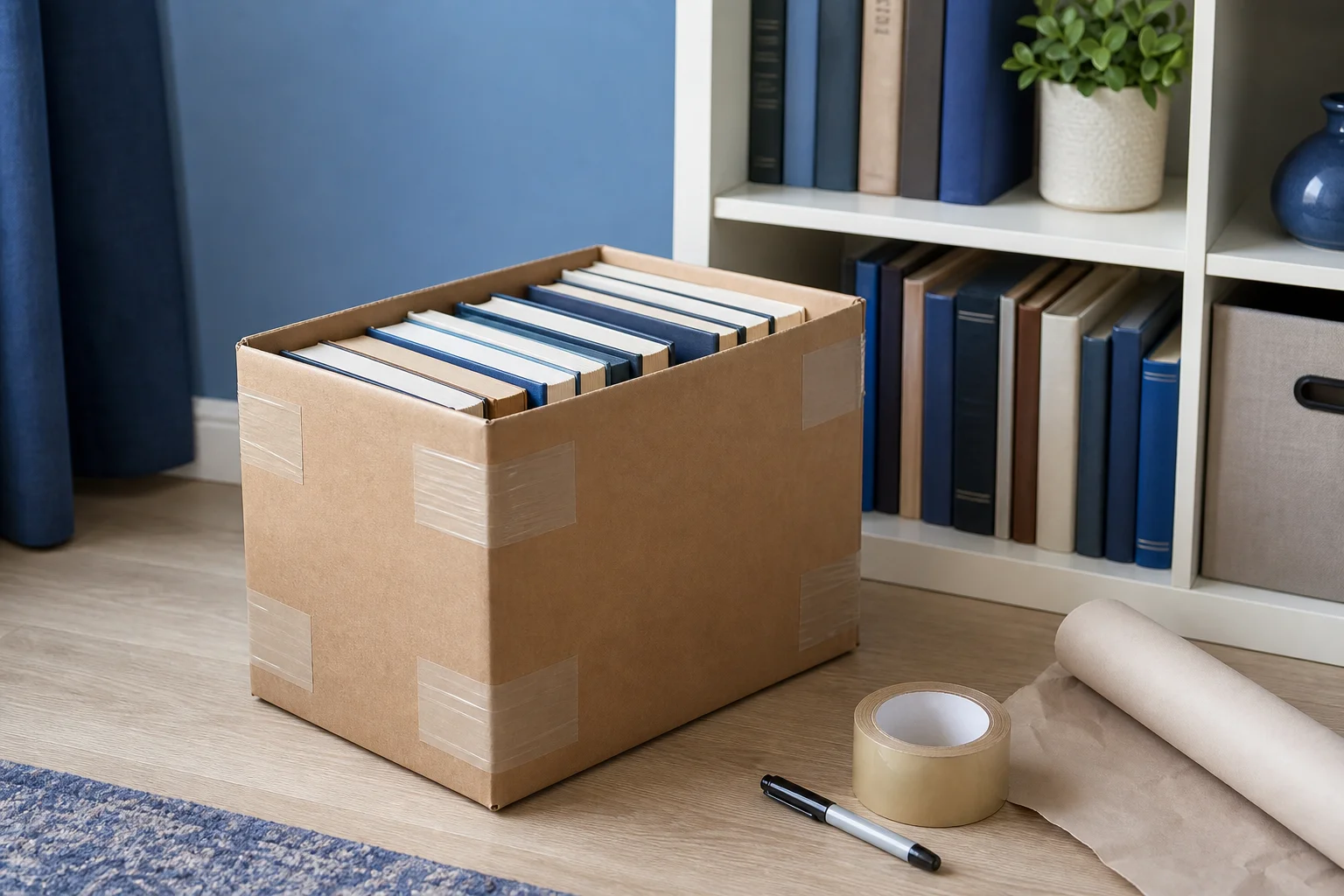
Small and medium books can often be packed upright, standing as they would on a shelf. This works best when the books are similar in height and fill the row well enough that they do not lean. They should be snug, not compressed.
Oversized and heavy books usually do better packed flat. Coffee-table books, photo albums, scrapbooks, yearbooks, atlases, and large art books need broad support under the cover and pages. Put the largest and heaviest volumes on the bottom, then lighter books above them.
Some preservation guidance also recommends packing books flat with heavier volumes underneath, or vertically with the spine down. Spine down means the spine rests on the bottom of the carton and the pages face upward. It is not the same as placing the book with the spine facing upward.
Match the packing method to the book type
Choosing the right orientation is easier when books are already sorted. Standard paperbacks, textbooks, fragile jackets, and oversized volumes all behave differently inside a moving carton. Use the method that gives each book the most support with the least pressure.
Do not force one method across the whole collection. A single box might include upright rows of standard books with a few flat oversized books in a separate layer, as long as the weight is balanced and the books are protected. The goal is controlled support, not rigid uniformity.
Use these practical comparisons when packing:
Upright packing: Best for many small and medium books that can stand evenly, as long as the row is supported and not squeezed.
Flat packing: Best for oversized, heavy, flexible, or fragile books that need full cover and page support.
Spine-down packing: Useful when the binding and box layout allow continuous support, especially for books where preservation matters.
Avoid diagonal or unsupported books: Leaning books can bend covers, stress bindings, and shift during transport.
Padding, sealing, labeling, and dry storage protect books after the box is packed
Good packing does not stop once the books are in the carton. Empty space, poor sealing, weak stacking, moisture, and vague labels can all create problems during the move and after arrival.
Start with a cushioning layer at the bottom of the box, then load books so the weight stays centered and evenly distributed. Use crumpled packing paper to fill side gaps, corners, and the top void. The box should close naturally without bulging, and the contents should not slide when gently moved.
Valuable books need more protection. Rare, antique, signed, first-edition, leather-bound, or fragile books should be wrapped individually in acid-free tissue or paper. If a dust jacket is loose, collectible, or fragile, protect it from rubbing, creasing, or tearing by using tissue and flat support.
Once the carton is packed, seal it securely and inspect the bottom before lifting. Place heavier book cartons on the floor or lower in a stack, with lighter boxes above. One moving box guide advises placing heavier boxes at the bottom and limiting stacks according to box guidance.
Label every book box so the right carton reaches the right room
Label every carton on at least two sides and the top. Include the destination room, broad category, box number, and handling instruction. Examples include “Study, Reference, 03 of 12,” “Bedroom, Children’s Books, Priority,” or “Collector’s Editions, Keep Upright, Do Not Stack Heavy.”
For organized collections, record the original shelf or sequence when practical. Pack authors, series, or subjects together and mark whether a box contains the beginning or end of a shelf. This helps you find school books, children’s favorites, work references, or important personal volumes without opening every carton.
Keep packed books away from rain, wet pavement, condensation, leaking roofs, and uncontrolled storage areas. Basements, attics, garages, hot vehicles, and damp containers can create avoidable risk, especially for valuable or fragile books. If books become wet or show active mold, separate them from the rest of the collection and seek appropriate preservation guidance.
Specialty packing makes sense for valuable, fragile, or unusually large collections
Ordinary household books usually move well in small reinforced cartons with careful weight control. Specialty packing becomes more useful when books are rare, antique, signed, leather-bound, first edition, mold-prone, water damaged, or valuable for financial or sentimental reasons.
Archival cartons, acid-free materials, custom-sized boxes, and individual wrapping can reduce movement and protect delicate bindings or jackets. Professional packing help may also make sense when the collection is large, stairs are involved, the move is long-distance, or no one can safely lift repeated 35 to 40 pound cartons.
If you are preparing a book collection for a move, focus on small boxes, manageable weight, supported packing positions, clean padding, dry handling, and clear labels. For help planning the safest packing approach for your books, reach out through the contact options on this website.


.webp)


.webp)
.webp)


.webp)


.webp)
.webp)

.webp)